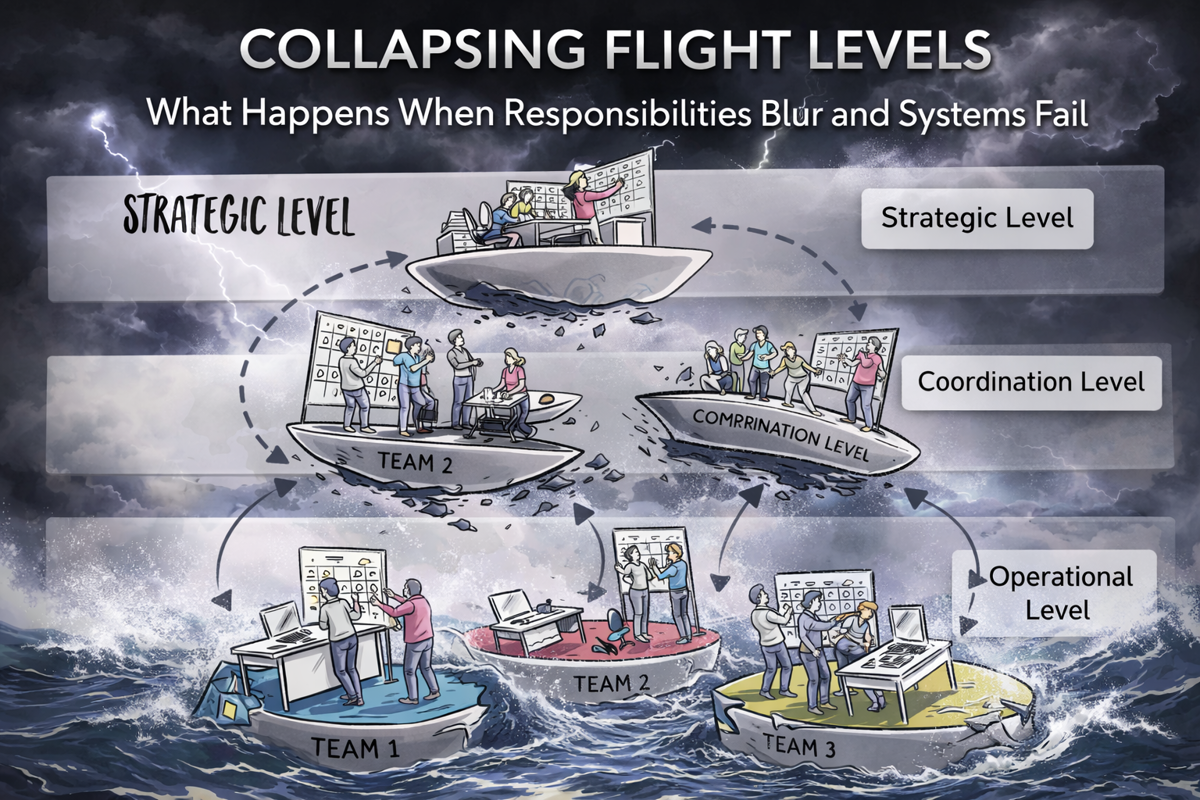
Most organisations do not fail because they lack effort.
They fail because their system is working against them.
Flight Levels provides a way of understanding how work should flow through an organisation. But the more important insight is what happens when those levels are not functioning properly.
Because they rarely fail in isolation.
They collapse.
What Collapse Actually Means
Flight Levels collapse when the boundaries between strategy, coordination, and execution blur.
Responsibilities shift.
Work moves to the wrong level.
And parts of the system begin compensating for others.
It does not feel like collapse.
It feels like:
- people stepping up
- leaders getting involved
- teams taking ownership
But underneath, something more damaging is happening.
The system is losing coherence.
Collapse Pattern One: Strategy Falls Into Teams
Teams are told to be empowered. To own outcomes. To make decisions.
But without clear strategic alignment:
- priorities are inconsistent
- trade-offs are unclear
- teams optimise locally
Each decision makes sense in isolation.
Collectively, they create fragmentation.
What looks like autonomy becomes divergence.
Collapse Pattern Two: Coordination Falls Into Teams
This is the most common pattern.
When coordination is not designed, teams:
- chase dependencies
- negotiate sequencing
- manage cross-team work informally
They spend increasing time waiting, chasing, and re-planning.
From the outside, it looks like a delivery problem.
From the inside, it is a coordination problem.
Flow slows down, not because teams are ineffective, but because the system is.
Collapse Pattern Three: Operations Rise to Leadership
Leaders step in to unblock work.
They make tactical decisions. Resolve conflicts. Prioritise work.
It feels necessary.
But it is also a signal.
When leaders operate at the level of individual work items:
- strategy becomes reactive
- coordination becomes inconsistent
- teams become dependent on escalation
Leadership becomes part of the bottleneck.
The Impact on Organisations
When Flight Levels collapse, the effects are systemic.
Flow Degrades
Work spends more time waiting than moving.
Lead times increase.
Delivery becomes unpredictable.
Cognitive Load Increases
Teams are forced to think about:
- execution
- coordination
- prioritisation
All at once.
This reduces quality and increases burnout.
Decision Making Breaks Down
Decisions are made:
- without the right context
- at the wrong level
- under pressure
The system becomes reactive.
Local Optimisation Dominates
Teams improve their own performance.
But the system does not improve.
You get pockets of excellence inside a struggling organisation.
Leadership Becomes a Constraint
Leaders spend more time reacting than shaping.
The system depends on intervention.
Which makes it fragile.
Why This Happens
There are consistent underlying causes.
The System Was Never Designed
Most organisations evolved.
Coordination layers emerged informally.
No one owns the system.
Coordination Is Undervalued
Execution is visible.
Strategy is visible.
Coordination sits in the middle and is often ignored.
Until it becomes the bottleneck.
Autonomy Is Misunderstood
Autonomy without alignment leads to fragmentation.
Not performance.
Metrics Reinforce the Wrong Behaviour
Teams are measured locally.
Flow is not measured across the system.
So the system does not improve.
The Hard Truth
When Flight Levels collapse, the instinct is to fix teams.
Improve processes. Add ceremonies. Increase oversight.
But the problem is not inside the team.
It is in the system those teams are operating within.
The Question That Matters
If you wanted to understand whether your Flight Levels are collapsing, you would ask:
Who owns coordination across teams?
And then:
What happens when work is blocked across the system?
If the answer involves:
- escalation
- informal conversations
- leadership intervention
Then the system is compensating for something missing.
Most organisations do not have a people problem.
They have a system problem.
Flight Levels collapse makes that visible.
And once you see it, you have a choice.
Continue compensating.
Or redesign the system.