Most engineering organisations do not struggle because their teams are ineffective.
They struggle because the system those teams operate within is unclear, fragmented, and misaligned.
Work starts, but does not flow. Priorities shift, but do not land. Teams deliver, but outcomes do not materialise in the way leadership expects.
Flight Levels exists to make that system visible.
What Flight Levels Actually Is
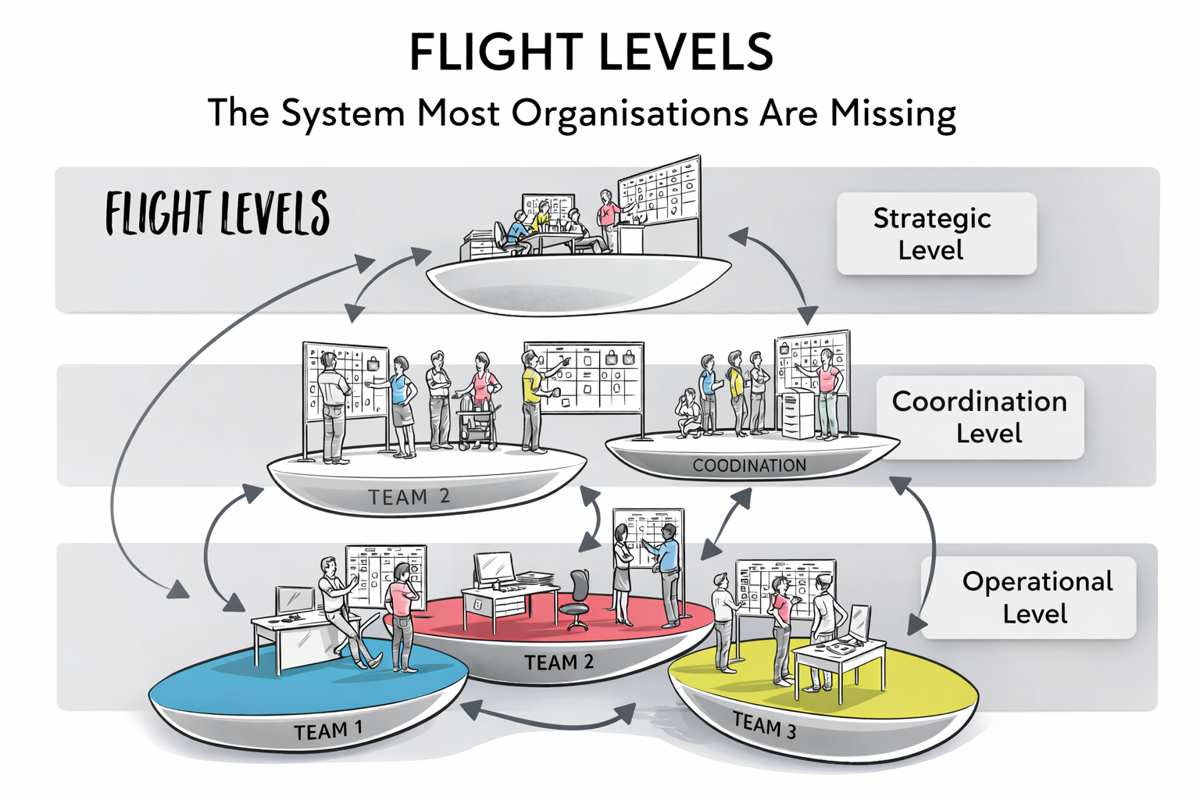
Flight Levels is a way of understanding how work moves through an organisation.
Not just within teams, but across the system.
It separates organisational activity into three levels:
- Flight Level 1 – where work is executed by teams
- Flight Level 2 – where work is coordinated across teams
- Flight Level 3 – where direction and priorities are set
These levels already exist in every organisation.
The difference is whether they are:
- implicit and chaotic
- or explicit and designed
The Problem Flight Levels Solves
Without a clear view of these levels, organisations experience predictable problems.
- Teams optimise locally, but the system performs poorly
- Dependencies dominate delivery timelines
- Priorities shift faster than work can complete
- Leaders intervene frequently just to keep things moving
From the outside, it looks like a delivery problem.
In reality, it is a system problem.
Flight Levels helps you see:
- where work is getting stuck
- where decisions are being made at the wrong level
- where coordination is missing or ineffective
The Five Activities
Flight Levels is not just a model. It is a set of activities that make the system visible and improve it over time.
1. Visualise the Situation
You cannot improve what you cannot see.
Most organisations track work within teams, but not across them.
Visualising the system means:
- seeing work across value streams
- understanding where work is waiting
- making dependencies explicit
This is often the moment where reality becomes uncomfortable.
Because the amount of waiting, rework, and hidden complexity is usually far higher than expected.
2. Create Focus
Organisations do not suffer from a lack of work.
They suffer from too much work in progress.
Creating focus means:
- limiting how much work is active across the system
- aligning around fewer priorities
- making trade-offs explicit
Focus is what allows flow to emerge.
Without it, everything starts, and nothing finishes.
3. Establish Agile Interactions
Flow does not improve through visibility alone.
It improves through interaction.
This means creating structured ways for:
- teams to coordinate
- leaders to make decisions
- dependencies to be resolved
Not through escalation.
Through intentional, regular interaction at the right level.
4. Measure Progress
Most organisations measure activity.
Few measure flow.
Measuring progress in a Flight Levels system means understanding:
- how long work takes to move
- where it gets stuck
- how often it completes
This shifts the conversation from: "Are we busy?"
to:
"Is work actually flowing?"
5. Improve
The previous four activities create awareness.
This one creates change.
Improvement is not about isolated optimisation.
It is about:
- removing systemic bottlenecks
- redesigning coordination
- aligning decisions across levels
It is continuous, because the system is always evolving.
Why These Activities Matter
Individually, each activity is useful.
Together, they change how organisations operate.
They shift the focus:
- from teams to systems
- from activity to flow
- from output to outcome
They make it possible to answer questions that most organisations avoid:
- Where is work actually getting stuck?
- Why does it take so long to deliver value?
- What would need to change for this to improve?
The Real Value of Flight Levels
Flight Levels does not make teams better.
It makes the system they operate in coherent.
When that happens:
- teams move faster without working harder
- leaders spend less time firefighting
- decisions become clearer and more consistent
Work flows.
Not because people try harder.
But because the system allows it.
Most organisations do not need more frameworks.
They need to see how their system actually works.
Flight Levels gives them that visibility.
And once they have it, the real work can begin.